Visualizzazione post con etichetta carnet de voyage. Mostra tutti i post

04 febbraio 2013

Il Ponte all'Indiano - Indiano Bridge


Guarda, siamo vicini al Ponte all'Indiano, l'ultimo dei ponti di Firenze. Nacque vantando primati ingegneristici, ma oggi nessuno lo ammira se non per la sua utilità, nota solo a chi si sposta in automobile.
A me ha sempre ispirato tenerezza, ricordandomi la storia del principe indiano di passaggio a Firenze che morì all'improvviso e le cui ceneri furono sparse qui, secondo il rito indù, alla confluenza di due fiumi, l'Arno e il Mugnone. Aveva appena 21 anni, era il 1870.

(matite acquerellabili su carta Canson Montval Aquarelle 24x36 cm)

Look, we are near Indiano Bridge, the last of Florence's bridges. It was born boasting of its engineering achievements, but today nobody admires it but for its utility, known only by those who get round by car.
To me it has always inspired tender feelings, reminding me of the story of the Indian prince passing through Florence who suddenly died and whose ashes were spread here, in accordance with the Hindu ritual, at the confluence of two rivers: the Arno and the Mugnone. He was just 21, it was 1870.
(water-soluble pencils on Canson Montval Aquarelle paper 9,5x14")

08 gennaio 2013

La passeggiata - The walk


Vieni con me. Ti farò vedere la strada bianca che costeggia l'Arno e la ferrovia, percorrendo il corridoio verde, immenso retro cortile della città, che termina ai Renai, dove i detriti portati dal fiume hanno formato un ricco giacimento di rena.
So che non mi dirai che c'è poco da vedere, o che non ti interessa: nessuno come te sa trovare ciò che è bello, o degno di attenzione ovunque, anche in mezzo al deserto, anche in un giorno nuvoloso come oggi.

(matite acquerellabili su carta Canson Montval Aquarelle 24x36 cm)

Come with me. I'll show you the white road that runs along the river Arno and the railway, going through the green corridor, immense back yard of the city, which finishes at i Renai, where the debris brought by the river have formed a rich deposit of sand.
I know you won't tell me that there isn't much to see, or that you don't find it interesting: nobody knows better than you how to find what is beautiful or deserving attention everywhere, even in the middle of a desert, even on a cloudy day like this.

(water-soluble pencils on Canson Montval Aquarelle paper 9,5x14")

04 ottobre 2012

Carnets disegni parole alla mostra Matite in Viaggio - Carnets drawings words at Matite in Viaggio exhibition


Dal 5 al 21 ottobre alcuni miei acquerelli saranno alla mostra Matite in Viaggio a Mestre, insieme ai lavori di molti bravissimi disegnatori.
Ne mostro qui alcuni piccoli estratti (nelle prossime settimane li presenterò ad uno ad uno). Si tratta di una serie dal titolo "Seguendo l'Arno dall'Indiano ai Renai - Diario di un giorno perfetto lungo la riva destra dell'Arno".
...Il mio consiglio per tutti gli appassionati di taccuini di viaggio è quello di non perdere questo bellissimo evento!

From 5 until 21 October some of my watercolours will be at the Matite in Viaggio exhibition in Mestre, together with the works by many wonderful sketchers.
I show here a few small excerpts (in the next weeks I'll present them one by one). It's a series called "Following the Arno from the Indiano to the Renai - Diary of a perfect day along the right bank of the Arno".
...My advice for all the lovers of travel sketchbooks is not to miss this beautiful event!

29 agosto 2012

Diario di viaggio dalla Costa Azzurra - Travel sketchbook from the French Riviera

La novecentesca villa Thérylos a Beaulieu-sur-Mer vista dalla spiaggia di Beaulieu
The twentieth century Villa Thérylos in Beaulieu-sur-Mer seen from the beach of Beaulieu

Sulla spiaggia di Frejus, all'avvicinarsi del tramonto
On Frejus beach, while sunset is approaching

il lungomare di Mentone, visto dalla spiaggia
The promenade in front of the sea in Menton, seen from the beach

Non ero mai stata in Costa Azzurra, perciò tutte le cose che ho visto quest'anno durante la mia vacanza fra Mentone e Frejus, in un lungo tratto di costa ricco di attrattive paesaggistiche, artistiche e storiche, hanno lasciato un'impronta che resterà per sempre legata ai ricordi di questa estate. 
La deliziosa Antibes con il sorprendente Museo Picasso dentro il Castello Grimaldi affacciato sul mare, Villa Ephrussi a Saint Jean Cap Ferrat con i suoi bellissimi giardini oltre alla vista unica sulla Baia degli Angeli e la Baia delle Formiche, Cannes e la Croisette, la piacevolezza di piccoli antichi centri come Saint Paul de Vence, Grasse, Biot, e molte altre cose ancora...
(Fra le più insolite, la Villa Thérylos di Beaulieu-sur-Mer, con la quale l'eccentrico studioso Théodore Reinach intese realizzare, in piena Belle Epoque, la ricostruzione di un palazzo della Grecia antica, ritratta in uno dei miei acquerelli).
E infine Nizza, della quale ho ammirato gli eccezionali musei, gli intriganti quartieri, e sopra ogni cosa, la magnifica luce sul mare che nei mattini d'estate si può godere passeggiando sulla Promenade des Anglais.
(acquerello su carta Fabriano 12,5x18 cm)

I had never been in the French Riviera before, so all the things that I saw this year during my holiday between Menton and Frejus, on a long stretch of coast rich of landscape, artistic and historical attractions have left a mark that is going to stay forever tied to the memories of this summer.
The delightful town of Antibes with the surprising Picasso Museum inside the Grimaldi Castle facing the sea, Villa Ephrussi in Saint Jean Cap Ferrat with its beautiful gardens and besides that its unique view on the Baie des Anges and the Baie des Fourmis, Cannes and the Croisette, the pleasantness of small ancient towns like Saint Paul de Vence, Grasse, Biot, and many more things...
(Among the oddest ones, the Villa Thérylos in Beaulieu-sur-Mer, with which the  eccentric scholar Théodore Reinach intended to build, in the middle of the Belle Epoque, the reconstruction of a palace of the ancient Greece, portrayed in one of my watercolours).
And at last Nice, of which I have admired the extraordinary museums, the intriguing quarters and, above all, the magnificent light on the sea that in the summer mornings one can enjoy walking on the Promenade des Anglais.
(watercolour on Fabriano paper 5"x7")

25 agosto 2011

Viaggio in Dalmazia - Trip to Dalmatia (3)

Dubrovnik
La chiesa di San Biagio
The church of Saint Blaise

Dubrovnik
La chiesa di San Salvatore
The Saint Saviour Church

Dubrovnik
Le mura e porta Pile
The walls and the Gate of Pila


Nel nostro giro non poteva mancare una visita a Dubrovnik, antica città di origine romana, sottomessa a Venezia dal 1204, quindi repubblica indipendente dalla metà del XIV secolo, un tempo ricchissima grazie alle attività commerciali favorite dalla sua posizione nel Mediterraneo, finché un terribile terremoto nel 1667 segnò il suo declino.
La città attuale è il risultato della ricostruzione operata in epoca barocca all'indomani del terremoto, e nonostante le distruzioni subite durante l'assedio del 1991-92, ha mantenuto la sua straordinaria eleganza in cui convivono gotico veneziano, rinascimento fiorentino, testimonianze barocche e resti medievali, in un insieme raffinato e splendente grazie alla chiara pietra calcarea utilizzata come materiale da costruzione oltre che per le eleganti pavimentazioni delle strade, oggi lucide per l'usura.
Solo il primo di questi tre schizzi è stato realizzato direttamente sul posto; non ho potuto fare di meglio a causa del caldo, della luce quasi insostenibile, delle folle di turisti in ogni dove, soprattutto comitive di gite organizzate, che giungono qui in pullman o a bordo di gigantesche navi da crociera.


In our tour, we couldn't miss visiting Dubrovnik, ancient city of Roman origin, subject to Venice from 1204, then independent republic from the middle of the Fourteenth Century, once very wealthy thanks to the trade business favoured by its position in the Mediterranean, until a terrible earthquake in 1667 marked its decline.
The city of today is the result of the reconstruction made in the baroque period after the earthquake, and despite the destruction due to the siege of 1991-92, it has maintained its extraordinary elegance where Venetian gothic, Florentine renaissance, baroque evidences and Middle Ages remains live together in a refined whole, shining for the clear calcareous stone used as building material and also for the elegant paving of the the streets, now bright for the usage.
Only the first of these sketches was made directly on location; I couldn't do better because of the heat, the almost unsustainable light, the crowds of tourists everywhere, especially organized groups that come here by coach or on board of huge cruise ships.

22 agosto 2011

Viaggio in Dalmazia - Trip to Dalmatia (2)

La collina a est di Pupnatska Luka
The hill east of Pupnatska Luka

Le isole a sud di Korčula viste da Pupnatska Luka
The islands south of Korčula seen from Pupnatska Luka

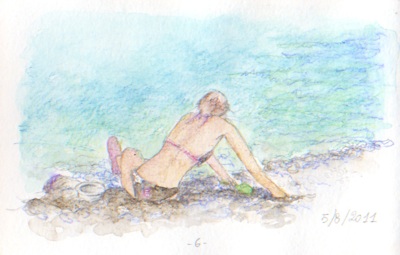
Una giovane mamma gioca con la sabbia sulla spiaggia
A young mother plays with sand on the beach


La Dalmazia con le sue isole è nota per le sue acque pulite e trasparenti, mentre non è affatto facile trovare spiagge ampie e comode, trattandosi di una costa frastagliata e rocciosa, spesso resa accessibile ai bagnanti da deludenti banchine in cemento.
A Korčula invece esistono belle spiagge di ciottoli, come quella di Pupnatska Luka, dove abbiamo passato una piacevole, riposante giornata circondate dal verde intenso delle colline ricoperte di pini e dai colori cangianti del mare e delle isole intorno.

Dalmatia with its islands is known for its clean, transparent waters, while it isn't easy at all to find wide, comfortable beaches, since the coast is rocky and jagged, often made accessible to bathers through disappointing concrete docks.
In Korčula instead there are beautiful pebble beaches, like the one of Pupnatska Luka, where we spent a pleasant, relaxing day surrounded by the intense green of the hills covered with pines and by the changing colours of the sea and the islands all around.

20 agosto 2011

Viaggio in Dalmazia - Trip to Dalmatia (1)

Nel porto di Ancona prima della partenza
In Ancona harbour before departure

Ancona - Il porto e la città visti dalla nave
Ancona - The harbour and the city seen from the ship

Sulla nave da Spalato a Korčula
On the boat from Split to 
Korčula


Sono riuscita a tenere un piccolo taccuino durante il viaggio in Dalmazia che ho fatto questa estate insieme a due amiche; non sempre a causa della fretta, della folla o delle circostanze mi è stato possibile ritrarre dal vero gli scorci e i panorami migliori, ma è stato divertente fermare con schizzi veloci i colori e le emozioni di alcuni momenti che sarà bello ricordare.
Questi sono gli schizzi fatti con le matite acquerellabili durante il tragitto in nave, prima dal porto di Ancona a Spalato, poi da Spalato all'incantevole isola di Korčula.
Durante il viaggio, si continua attraverso le letture e i discorsi a fantasticare su quello che ci aspetta, costruendo nella nostra mente una Dalmazia immaginaria, mentre quella reale inizia a manifestarsi intorno a noi attraverso il blu del Mare Adriatico e la magnifica luce di belle giornate di inizio agosto.


I have managed to keep a small sketchbook during the trip to Dalmatia that I've made this summer together with two friends of mine; because of haste, crowds or other circumstances I couldn't always portray on location the best views and landscapes, but it has been a fun fixing on quick sketches the colours and feelings of some moments that I will like to remember.
These are the sketches made with water-soluble pencils during the journey on the ship, at first from the harbour of Ancona to Split, and then from Split to the enchanting island of Korčula.
During the journey, reading books and talking, we keep on dreaming on what is ahead for us, building in our minds an imaginary Dalmatia, while the real one begins to show itself through the blue of the Adriatic Sea and the magnificent light of sunny days of early August.