Visualizzazione post con etichetta waterbrush. Mostra tutti i post

20 aprile 2017

Piazza San Firenze


Fra Palazzo Vecchio e il Bargello, si apre lo spazio di questa piazza, reso spettacolare dalla presenza del settecentesco Oratorio dei Filippini, fino a pochi anni fa sede del Tribunale di Firenze, oggi in attesa di una prossima futura destinazione.
Un luogo in fase di transizione: sarà forse per questa sua affascinante qualità che in un sabato dello scorso febbraio lo ho scelto per aprire la serie di acquerelli del mio carnet dedicato a nove piazze di Firenze. A seguire, presto, le altre otto.
(matita a olio e acquerello su carta Arches 31x20,5 cm)

Between Palazzo Vecchio and the Bargello, the space of this square opens, made spectacular by the presence of the eighteenth-century Oratorio dei Filippini, which was until a few years ago the seat of the Court of Florence, and today is waiting for a near future destination.

A place in transition: it is perhaps for this fascinating quality that on a Saturday of last February I chose it to open the series of watercolours of my carnet dedicated to nine squares of Florence. Next, soon, the other eight.

(oil pencil and watercolour on Arches paper, 12"x8")

06 novembre 2016

Piazza San Marco


La vita non scorre sempre continua, a volte fa dei salti. E dopo, anche i luoghi familiari non sembrano più gli stessi. Questa è piazza San Marco a Firenze, in un pomeriggio d'autunno che è un po' meno luminoso di come ricordavo fossero gli autunni, prima.

Life does not always flows continuously, sometimes it makes jumps. And then, even familiar places seem no longer the same. This is Piazza San Marco in Florence, in an autumn afternoon that is a little less bright than I remembered were the autumns, before.

09 dicembre 2012

Finestre - Windows


In città cammino spesso con la testa all'insù, amo osservare i dettagli in tutto quello che mi circonda, non necessariamente per trovare un soggetto interessante da dipingere.
Cedo spesso anche alla tentazione di allungare lo sguardo oltre i vetri delle finestre: non lo farei se conoscessi chi vi abita, ma se si tratta di appartamenti o palazzi in cui vivono degli sconosciuti, entrare in contatto con qualche frammento delle loro vite non è per me diverso dall'aprire le pagine di un romanzo, nel quale certi particolari apparentemente minimi possono rivelare storie, fatti e persone meglio di mille parole.
La realtà, certo, porta con sé emozioni ben più grandi di qualsiasi romanzo, soprattutto per me che non posso fare a meno di entrare in empatia con chiunque, come se ad ogni nuovo incontro un incantesimo mi portasse a sperimentare (o almeno, a tentare di farlo), quello che sentirei stando nei panni dell'altro.
In questo caso, un gioco di riflessi sui vetri ha limitato le mie introspezioni, mentre al contrario la via stretta e poco frequentata ha messo me al centro della scena davanti agli occhi di qualcuno che si è affacciato alla finestra. Questo non mi ha impedito di perdermi nelle curve sinuose di questi deliziosi parapetti in ferro, unico ornamento di una delle vecchie case a schiera di via San Gallo, proprio sopra alla storica cartoleria Mugnai, aperta dal 1868.
(penna a inchiostro indelebile e matite acquarellabili su taccuino da viaggio Winsor and Newton 14,9x21 cm).

In the city I often walk looking upwards, I love observing any detail in everything around me, not necessarily in order to find an interesting subject for a painting.
I also often give in to the temptation to cast a glance beyond the window panes: I wouldn't do it if I knew who is living there, but if it's a flat or a palace inhabited by unknown people, getting in touch with pieces of their lives to me isn't so different from opening the pages of a novel, in which certain details apparently minimal can reveal stories, facts, people better than a thousand words.
Reality, of course, brings stronger feelings in comparison to any novel, especially for me, as I can't help feeling empathy for anyone, as though at every new encounter a spell forced me to experiment (or at least to try to do it), what I would feel if I put myself in another's shoes.
In this case, a game of reflections on the panes limited my introspection, while on the contrary the narrow, sparsely populated street put me in the centre of the scene for someone who was looking out of the window.
This didn't restrain me from losing myself in the winding curves of these lovely iron rails, sole ornament of one of the old row houses of via San Gallo, just over the historic stationery store Mugnai, open from 1868.
(waterproof ink liner and watercolour pencils on travel sketchbook Winsor & Newton 5,8"x8,3" cm).

02 dicembre 2012

La piena - The flood


Questo non è un disegno dal vivo, né è stato eseguito a partire da una foto. È la registrazione di un'impressione, e anche di un'emozione, quella che ho provato qualche giorno fa quando passando sul vecchio ponte di Scandicci, ho visto la Greve in piena scorrere con impeto in modo quasi minaccioso, come forse non avevo mai visto prima.
Il paesaggio intorno è più invenzione che ricordo, ma in fondo mi sono detta che non è importante, in questo caso.
(Acquerelli e matite acquarellabili su carta Fabriano "Blocco per Artisti" 12,5x18 cm)

This is not a location drawing, nor it has been made from a photo. It's the record of a feeling, and also of an emotion, the one that I felt a few days ago when, passing on the old bridge of Scandicci, I saw the flooding river Greve streaming impetuously in an almost threatening way, like maybe I had never seen before.
The landscape all around is more an invention than a memory, but after all I told myself that it isn't so important, in this case.
(Watercolour and water-soluble pencils on Fabriano paper 50% Cotton - neutral pH - 5"x7")

21 novembre 2012

Le serre dell'Orto Botanico - The conservatories of the Botanical Garden


Conosco molto bene questo incrocio, queste strade, e tuttavia non sono mai entrata in questo edificio che fa parte dell'Orto Botanico di Firenze. Solo dopo una piccola ricerca ho appreso qual è la sua specifica funzione: si tratta della serra calda dell'Orto Botanico, nella quale sono raccolte molte piante provenienti da paesi tropicali: dalla rara e singolare Amorphophallus, originaria di Sumatra, di dimensioni gigantesche (ha un'unica foglia di oltre 4 metri e un fiore di 3 metri di lunghezza), alle piante che ci sono familiari per l'importanza dei loro prodotti nella nostra vita quotidiana: il caffè, il cacao, il cotone, il pepe.
Sembra assurdo ma può succedere, in una città come Firenze, che certi tesori di primaria importanza passino in secondo piano rispetto alle infinite bellezze circostanti. Non tutti infatti sanno che l'Orto Botanico di Firenze, chiamato anche Giardino dei Semplici, oltre ad essere il terzo più antico del mondo essendo stato fondato nel 1545 (successivo solo quelli di Pisa e di Padova), costituisce da secoli un centro di studio e di ricerca botanica di rilievo internazionale.
Io stessa, lo ammetto, non l'ho mai contemplato se non dall'esterno, grazie alla vista che se ne può avere passando lungo via La Pira. Presto dovrò rimediare a questa mia mancanza.
(penna a inchiostro indelebile e matite acquarellabili su taccuino da viaggio Winsor and Newton 14,9x21 cm).

I know very well these crossroads, these streets, and yet I have never entered this building that is part of the Botanical Garden of Florence. Only after a brief research I learnt which is its specific purpose: it's the warm conservatory of the Botanical Garden, where many plants coming from tropical countries are collected: from the rare and singular Amorphophallus, native of Sumatra, of gigantic size (it has only one leaf more than 4 meters long and a flower 3 meters long), to the plants that are familiar to us for the importance of their products in our everyday life: coffee, cacao, cotton, pepper.
It seems absurd but it may happen, in a city like Florence, that certain treasures of primary importance are pushed in the background by the endless beauties all around. Not so many know in fact that the Botanical Garden of Florence, also called the Garden of Simples, apart from being the third most ancient in the world as it was founded in 1545 (following just the ones in Pisa and Padua), has been for centuries a prominent centre of study on a worldwide scale.
I myself, I must admit, have always admired it just from the outside, thanks to the view that one can enjoy passing along via La Pira. Soon I'll have to make up for this lack of mine.
(waterproof ink liner and watercolour pencils on travel sketchbook Winsor & Newton 5,8"x8,3" cm).

13 novembre 2012

Olivi in Piazza San Giovanni - Olive trees in Piazza San Giovanni


Ho già parlato in passato del Battistero di Firenze, della sua apparenza enigmatica, della sua geometria ossessiva che sembra irradiarsi lungo linee invisibili sull'intera città.
La settimana scorsa ho saputo che in occasione della Biennale Internazionale dei beni culturali e Ambientali Florens 2012 una settantina di olivi secolari erano stati disposti in piazza San Giovanni, mettendo il Battistero al centro di un'installazione urbana.
Mi sono chiesta se gli olivi sarebbero riusciti a ingentilire la durezza di questo edificio sacro e tuttavia, come è stato scritto, "intellettualmente terribile".
Sono andata a verificare e, provando a ritrarre in un disegno l'insolito aspetto della piazza mi sono resa conto che continuavo a percepire il Battistero allo stesso modo di sempre, mentre gli olivi sembravano essere stati catturati dalla sua oscura potenza dominatrice, come vittime di un incantesimo.
Per vedere i miei due post precedenti sul Battistero, fate clic qui e qui.
(penna a inchiostro indelebile e matite acquarellabili su taccuino da viaggio Winsor and Newton 14,9x21 cm).

In the past I have already spoken of the Baptistry of Florence, of its enigmatic look, of its obsessive geometry that seems to radiate along invisible lines all over the city.
Last week I heard that on the occasion of the International Biennial of Culture and Environment, Florens 2012, approximately seventy centuries-old olive trees had been arranged in Piazza San Giovanni, putting the Baptistry in the centre of an urban installation.
I asked myself if the olive trees would manage to soften the hardness of this building, sacred yet, as someone wrote, "intellectually terrible".
I went to verify and, trying to portray in a sketch the unusual look of the square I realized that I was still perceiving the Baptistry as ever before, while the olive trees seemed to be captured by its obscure dominant power, like victims of a spell.
To see the two posts that I previously dedicated to the Baptistry, clic here and here.
(waterproof ink liner and watercolour pencils on travel sketchbook Winsor & Newton 5,8"x8,3" cm).

03 novembre 2012

Il silenzio di via San Gallo - The silence of via San Gallo


Via San Gallo ha qualcosa di indefinibile che al tempo stesso mi respinge e mi affascina.
Passandoci, nonostante le innumerevoli finestre dalla quali ci si può facilmente sentire osservati, si avverte una sensazione di chiusura che rende questa via impenetrabile, misteriosa. Forse tutto questo si può spiegare se si considera che nel corso dei secoli lungo questa via sono sorti uno dopo l'altro numerosi conventi, chiese, ospizi di pellegrini che ne hanno segnato in modo indelebile il carattere.
Lo stesso nome della via deriva dalla chiesetta sorta nel 1218 poco lontano, lungo il Mugnone, in onore di San Gallo, che nel Quattrocento fu ampliata unendovi un grande monastero "capace di cento frati". Il convento fu poi distrutto nel 1530 dagli stessi fiorentini per ostacolare l'imminente assedio della città da parte dell'esercito imperiale, ma ancora oggi, lungo la via, esistono la chiesa di San Clemente con annesso monastero femminile, il monastero delle Mantellate, chiamate così per il loro caratteristico mantello, la chiesa e il monastero anch'esso femminile dedicati a Sant'Agata.
Nel mio acquerello eseguito dal vivo, ho ritratto il grande tabernacolo con l'Assunta nei pressi di via San'Anna. A pochi passi da lì, quasi alle mie spalle, il vecchio Ospedale di Bonifacio, fondato nel 1377, destinato nel Cinquecento ai contagiati di sifilide e nel Settecento ai malati psichiatrici (oggi occupato dalla Questura), che di certo contribuisce insieme a tutto il resto a fare di via San Gallo un luogo tranquillo eppure scomodo.
Trovate qui un'altra eloquente immagine di via San Gallo in un mio acquerello di circa un anno fa.
(penna a inchiostro indelebile e matite acquarellabili su taccuino da viaggio Winsor and Newton 14,9x21 cm).

Via San Gallo has some indefinible feature that at the same time pushes me away and fascinates me.
Passing here, despite the numerous windows from which one may easily feel observed, we are touched by a feeling of closure that makes this street impenetrable, mysterious. Maybe this can be explained if we consider that in the course of the centuries many convents, churches, pilgrims' hospices were erected one after another along this street, permanently marking its character.
The name of the street itself derives from the small church built in 1218 a short way from here, along the river Mugnone, in honour of Saint Gallus, which in the Fifteenth century was enlarged and joined to a large monastery "accomodating one hundred friars". The convent was then destroyed in 1530 by the Florentines to oppose the imminent siege of the city by the Imperial Army, but still today along the street exist the church of Saint Clement with the adjoining convent of nuns, the Monastery of the Mantellate, so called for their characteristic mantle (mantello in Italian), the church and the monastery, also that of nuns, dedicated to Saint Agatha of Sicily.
In my watercolour made on location, I portrayed the big tabernacle with the Assumption of Mary (popularly named Assunta) near via Saint Anne. A few steps away from there, nearly at my back, the old Hospital of Bonifacio, founded in 1377, destined to the syphilis ills in the Sixteenth Century and to the psychiatric ills in the Eighteenth Century (today occupied by the Police Headquarters), which surely contributes together with all the rest to make via San Gallo a quiet yet uncomfortable place. 
Here you can find another eloquent image of via San Gallo in one of my watercolours of approximately one year ago.
(waterproof ink liner and watercolour pencils on travel sketchbook Winsor & Newton 5,8"x8,3" cm).

11 settembre 2012

La Cappella del Rosario di Vence - The Chapel of the Rosary in Vence


Fra le molte cose interessanti da vedere in Costa Azzurra, c’è questa piccola cappella progettata e costruita fra il 1948 e il 1951, il cui apparato decorativo fu interamente ideato da Henri Matisse. Fu una sua ex assistente nonché modella, successivamente divenuta suora, a coinvolgerlo in questo progetto: Monique Bourgeois, poi suor Jacques-Marie, legata a Matisse da una sincera amicizia.
Dal punto di vista architettonico si tratta di uno spazio estremamente semplice, mentre si rimane colpiti dai magnifici colori e dalle forme essenziali e tuttavia così espressive delle vetrate, chiaramente derivate dai noti esperimenti di Matisse denominati papiers gouachés découpés (carta dipinta a tempera ritagliata), in ampia parte visibili nel museo Matisse di Nizza.
È sconvolgente trovare tanta gioia di vivere espressa con modernissima semplicità di linee e purezza di colori in un artista che in quegli anni si trovava per lo più confinato a causa delle proprie condizioni di salute in un appartamento dell'Hotel Regina, presso Cimiez nei sobborghi di Nizza, spesso immobilizzato a letto o su una sedia a rotelle e costretto a farsi aiutare dalle sue assistenti.
Non c’è traccia di pessimismo: solo linee e colori felici, come se nei suoi ultimi anni, all'avvicinarsi della fine, Matisse avesse sentito il proprio amore per la vita, il sole e i colori più gioiosi della natura non spegnersi, ma anzi diventare cento, mille volte più grande di prima.
(acquerello su carta Fabriano 12,5x18 e 12,5x12,5 cm)


Among the many interesting things to see in the French Riviera, there is this little chapel designed and built between 1948 and 1951, whose decorations were entirely planned by Henri Matisse. It was a former assistant and model of his, later become a nun, who involved him in this project: Monique Bourgeois, then named soeur Jacques-Marie, bound to Matisse by a sincere friendship.
From the architectural point of view it's an extremely simple space, while one gets shocked by the magnificent colours and by the essential yet so expressive shapes of the windows, clearly deriving from the renown Matisse's experiments named papier gouachés découpés (paper cuts outs painted with gouache), largely exhibited in the Matisse Museum in Nice.
It's upsetting to find so much joy of living expressed with the most modern simplicity of lines and colour purity in an artist who in those years for his bad health was mostly confined in a flat inside the Hotel Regina at Cimiez, in the suburbs of Nice, often in bed or wheelchair-bound and compelled to be helped by his assistants.
There is no sign of pessimism: only happy lines and colours, as if in his last years, while the end was approaching, Matisse had felt his love for living, for the sun and for the most joyful colours in nature not turning off, but on the contrary becoming a hundred, a thousand times greater then before.
(watercolour on Fabriano paper 5"x7" and 5"x5")

29 agosto 2012

Diario di viaggio dalla Costa Azzurra - Travel sketchbook from the French Riviera

La novecentesca villa Thérylos a Beaulieu-sur-Mer vista dalla spiaggia di Beaulieu
The twentieth century Villa Thérylos in Beaulieu-sur-Mer seen from the beach of Beaulieu

Sulla spiaggia di Frejus, all'avvicinarsi del tramonto
On Frejus beach, while sunset is approaching

il lungomare di Mentone, visto dalla spiaggia
The promenade in front of the sea in Menton, seen from the beach

Non ero mai stata in Costa Azzurra, perciò tutte le cose che ho visto quest'anno durante la mia vacanza fra Mentone e Frejus, in un lungo tratto di costa ricco di attrattive paesaggistiche, artistiche e storiche, hanno lasciato un'impronta che resterà per sempre legata ai ricordi di questa estate. 
La deliziosa Antibes con il sorprendente Museo Picasso dentro il Castello Grimaldi affacciato sul mare, Villa Ephrussi a Saint Jean Cap Ferrat con i suoi bellissimi giardini oltre alla vista unica sulla Baia degli Angeli e la Baia delle Formiche, Cannes e la Croisette, la piacevolezza di piccoli antichi centri come Saint Paul de Vence, Grasse, Biot, e molte altre cose ancora...
(Fra le più insolite, la Villa Thérylos di Beaulieu-sur-Mer, con la quale l'eccentrico studioso Théodore Reinach intese realizzare, in piena Belle Epoque, la ricostruzione di un palazzo della Grecia antica, ritratta in uno dei miei acquerelli).
E infine Nizza, della quale ho ammirato gli eccezionali musei, gli intriganti quartieri, e sopra ogni cosa, la magnifica luce sul mare che nei mattini d'estate si può godere passeggiando sulla Promenade des Anglais.
(acquerello su carta Fabriano 12,5x18 cm)

I had never been in the French Riviera before, so all the things that I saw this year during my holiday between Menton and Frejus, on a long stretch of coast rich of landscape, artistic and historical attractions have left a mark that is going to stay forever tied to the memories of this summer.
The delightful town of Antibes with the surprising Picasso Museum inside the Grimaldi Castle facing the sea, Villa Ephrussi in Saint Jean Cap Ferrat with its beautiful gardens and besides that its unique view on the Baie des Anges and the Baie des Fourmis, Cannes and the Croisette, the pleasantness of small ancient towns like Saint Paul de Vence, Grasse, Biot, and many more things...
(Among the oddest ones, the Villa Thérylos in Beaulieu-sur-Mer, with which the  eccentric scholar Théodore Reinach intended to build, in the middle of the Belle Epoque, the reconstruction of a palace of the ancient Greece, portrayed in one of my watercolours).
And at last Nice, of which I have admired the extraordinary museums, the intriguing quarters and, above all, the magnificent light on the sea that in the summer mornings one can enjoy walking on the Promenade des Anglais.
(watercolour on Fabriano paper 5"x7")

29 luglio 2012

La Pagliazza e dintorni


Per lo Sketchcrawl n. 36 del 14 luglio scorso, insieme a Roberto, Jukio e Giacomo Filippo siamo andati a disegnare nella zona centrale di Firenze, vicino al Duomo, dove le strette strade della parte più antica della città offrono ombra anche nelle giornate più calde. Abbiamo cominciato i nostri schizzi nella piccola piazza Santa Elisabetta, dominata dall'antichissima Torre della Pagliazza. Dopo aver fatto qualche ricerca, ho scoperto che con il nome di "palliazza" si indicavano in genere le torri carcerarie, e infatti l'originaria funzione svolta dall'edificio fra il XII e il XIII secolo era quella di carcere femminile, mentre successivamente fu utilizzato come torre campanaria di una chiesa attigua, ormai non più esistente. Oggi fa parte di un albergo, ma continua ad attrarre l'attenzione dei turisti, che non mancano di fermarsi ad osservarla, incuriositi dalla sua storia e dalla sua unicità nel panorama cittadino, in quanto unica torre a pianta circolare giunta fino ai nostri giorni.
Nel secondo disegno ho ritratto una delle costruzioni che affacciano sulla piazza, con i caratteristici sporti, ovvero mensole in legno che reggono la parte superiore sporgente.
Qui ogni palazzo ha molte storie da raccontare, e viene voglia di perdersi dietro a ogni minimo dettaglio: purtroppo ho potuto dedicare solo un paio d'ore allo Sketchcrawl, e mi è dispiaciuto dover lasciare la compagnia troppo presto, quando ancora avevo voglia di disegnare e avrei voluto avere più tempo per conoscere meglio i miei compagni di disegno. Non mi resta che sperare nella prossima volta...
(matite acquarellabili su taccuino da viaggio Winsor and Newton 14,9x21 cm).


For the Sketchcrawl no. 36 of last July 14th, together with Roberto, Jukio and Giacomo Filippo we went to sketch in the central area of Florence, near the Cathedral, where the narrow streets of the oldest part of the city give shadow even in the hottest days. We started making our sketches in the little Piazza Santa Elisabetta, dominated by the age-old Torre della Pagliazza. After I made some research, I discovered that the name "palliazza" generally indicated the prison towers, in fact the building was at first used as a women's jail between the Twelfth and the Thirteenth Century, while later it was used as bell tower of a church nearby, now lost. Today it is part of a hotel, but it keeps on drawing to itself the attraction of tourists, who never fail to stop and look at it, intrigued by its history and by its uniqueness in the city, as it's the only tower with a round shaped plan that has survived until today.
In the second sketch I portrayed one of the buildings facing the square, with its characteristic sporti, i.e. wooden cantilevers sustaining the upper protruding part of the building.
Here every building has many stories to tell, and one feels like losing himself after every smallest detail: unfortunately I could dedicate just a couple of hours to the Sketchcrawl, and I was sorry to leave the company too early, when I was still feeling like sketching and I would have liked to have more time to get to know better my fellow sketchers. The only thing I can do is hope in the next time...
(watercolour pencils on travel sketchbook Winsor & Newton 5,8"x8,3" cm).

19 maggio 2012

Firenze segreta - Secret Florence


In questa giornata funestata da brutte notizie di violenza e terrore proveniente da Brindisi, un raggio di sole mi è stato portato dalla bella iniziativa organizzata da Massimo Montigiani consistente in uno sketchwalk di gruppo in una zona di Firenze che mi era totalmente sconosciuta.
Per arrivarci, dal Piazzale di Porta Romana, luogo dell'accesso meridionale all'antica cinta muraria di Firenze, sono entrata nel giardino delle Scuderie Reali, i cui locali sono oggi adibiti a Liceo Artistico. Un luogo bello, solare, allietato dalla presenza dei giovanissimi studenti e dei loro professori. Oltrepassato il giardino, sono uscita da un cancello posteriore e mi sono ritrovata in un quartiere che è mi sembrato appartenere al regno delle favole: silenzio, pace, villini con deliziosi giardini, decori ora austeri, ora leziosi, in un'insieme piacevolissimo. Tutt'intorno, il verde del meraviglioso Giardino di Boboli, del giardino del Bobolino e delle colline circostanti. Sono arrivata presto, e ancora rapita dallo stupore per questa scoperta, ho scelto un villino posto all'incrocio fra due strade, incuriosita dal suo aspetto singolare, che in realtà si ripete in tutti i villini che si affacciano sull'incrocio, e dall'insolito motivo dell'ape presente sul parapetto del balcone, forse richiamo all'emblema araldico di qualche antica famiglia legata a questo luogo o, più probabilmente, semplice simbolo dell'operosità degli abitanti di questo borgo, originariamente in gran parte artigiani.
Quando il gruppo degli altri disegnatori è arrivato, ciascuno ha scelto il proprio scorcio nei pressi e abbiamo passato insieme piacevoli ore, concentrati sui nostri disegni, scambiando fra di noi solo poche parole. Alla fine, quando si è avvicinato il momento di lasciarci, è nato uno scambio di consigli ed esperienze su penne, pennelli, acquerelli e tecniche, qualcosa di così bello che mi ha fatto desiderare che tutto questo possa ripetersi molto presto!
(matite acquarellabili su taccuino da viaggio Winsor and Newton 14,9x21 cm).


In this day struck by bad news of violence and terror coming from Brindisi, a ray of sunlight has been brought by the beautiful initiative organized by Massimo Montigiani, consisting of a group sketchwalk in an area of Florence that was completely unknown to me.
To get there, from the Piazzale di Porta Romana, southern access gate to the ancient walls of Florence, I entered the garden of the Royal Stables, whose rooms are now used as senior high school specializing in artistic education. A beautiful place, enlivened by the presence of the very young students and their teachers. After I passed the garden, I walked through a rear gate and I found myself in an area that seemed to belong to the realm of fairy tales: silence, peace, small houses with delicious gardens, decorations that were now sober, now mincing, forming an extremely pleasant whole. All around, the green of the marvellous Boboli Gardens, of the garden of Bobolino and of the surrounding hills. I arrived early, and still entranced by amazement for this discovery, I chose a small house at the crossroads between two streets, intrigued by its peculiar look, which actually repeats itself in each of the houses facing the same crossroads,  and by the unusual theme of the bee on the parapet of the balcony, maybe a reference to the heraldic emblem of some ancient family tied to this place or, more likely, simple symbol of the industriousness of the inhabitants of this suburb, originally mainly craftsmen.
When the group of the other sketchers arrived, each chose his own view around there, and we spent together pleasant hours, absorbed by our drawings, exchanging just a few words. At the end, when the time of leaving approached, we started exchanging advices and experiences about pens, brushes, watercolours and techniques, something so beautiful that made me desire that all of this can happen again early!
(watercolour pencils on travel sketchbook Winsor & Newton 5,8"x8,3" cm).

01 maggio 2012

Palazzo Uguccioni in Piazza della Signoria


La parola "Rinascimento", applicata come un'etichetta alle architetture che hanno reso famosa Firenze, si può accostare a oggetti così diversi per spirito, aspetto e momento storico in cui sono nati, da far pensare che si tratti di un termine in molti casi troppo generico, inadatto a descrivere la realtà.
Il palazzo Uguccioni di piazza della Signoria, ad esempio, rappresenta l'anima più classicistica della Firenze rinascimentale, direttamente collegata alle esperienze romane di Bramante e Raffaello e alla loro raffinatissima riproposizione dei canoni dell'architettura di Vitruvio.
Siamo quindi assai lontani tanto dal vecchio gusto tradizionalistico, ancora medievale, mai abbandonato dai magnati della città, quanto dalle forme spoglie e sobrie dell'architettura cosiddetta "piagnona", che dal 1494 divenne predominante in città per quasi un ventennio, espressione della Repubblica di Savonarola.
Il palazzo, realizzato da Mariotto di Zanobi Folfi detto "l’Ammogliato", risale al 1549, appartiene perciò al clima ancora pieno di incertezze dei primi anni del dominio di Cosimo de' Medici, non ancora granduca.
Oggi il palazzo appare come una sontuosa scenografia nella piazza dominata dall'imponente Palazzo Vecchio, e al piano terra ospita un bar ristorante i cui tavoli occupano parte della piazza. L'ho ritratto approfittando di un pugno di minuti rubati a un paio di sfolgoranti pomeriggi di sole, ascoltando il rumoroso brusio delle centinaia di persone intorno a me e, a tratti, la musica di un intrattenitore che eseguiva "Strangers in the Night" davanti ai clienti di un bar.
Trovate miei precedenti post su Savonarola qui e su Palazzo Vecchio qui.
(acquerello su carta Fabriano 12,5x18 cm).

The word "Renaissance", applied as a tag to the pieces of architecture that have made Florence famous in the world, can match many objects that are so different for  spirit, appearance and historical period in which they were born, to let think it's an extremely general term, incapable of describing reality.
Palazzo Uguccioni in Piazza della Signoria, for instance, represents the most classicistic side of Renaissance Florence, directly linked to the Roman experiences of Bramante and Raffaello and to their most refined proposal of the canon of architecture estabilished by Vitruvius. 
It's therefore very far both from the more traditional taste, still belonging to the Middle Ages, never given up by the magnates of the city, and from the sober, bare shapes of the so-called "piagnona" architecture (Piagnoni were Savonarola's devotees), which from 1494 became predominant in the city for almost two decades, expression of Savonarola's Republic.
The palace, built by Mariotto di Zanobi Folfi called "l’Ammogliato" ("the Married") dates back to 1549, so it belongs to the still uncertain climate of the first years of supremacy of Cosimo de’ Medici, not yet Grand Duke.
Today the palace appears as a sumptuous scene in the square dominated by the imposing Palazzo Vecchio, and at the ground floor it hosts a bar-restaurant whose tables occupy part of the square. I portrayed it using a handful of minutes stolen by a couple of afternoons shining with sun, hearing the noisy hum of the hundreds of people around me, and, at times, the music of an entertainer playing "Strangers in night" in front of the customers of a bar.
You can find my previous posts about Savonarola here and about Palazzo Vecchio here. 
(watercolour on Fabriano paper 5"x7")

15 aprile 2012

Primavera in piazza - Spring in the square


A Firenze ci sono sicuramente piazze più belle di questa, ma sono pochi i luoghi altrettanto piacevoli e luminosi.
Si tratta di piazza dell'Indipendenza, la prima piazza ottocentesca della città, intorno alla quale dal 1844 si sviluppò il quartiere detto "di Barbano" (che però oggi non viene più chiamato così), con le sue abitazioni che attrassero soprattutto la classe media.
Oggi vi si trovano un noto centro diagnostico, un piccolo ospedale, una sede universitaria, la sede della polizia scientifica, alcuni alberghi. Ma ciò che rende speciale questa piazza sono gli spazi verdi al centro, che nei diversi momenti della giornata attraggono persone e situazioni diverse. Così, nella pausa del pranzo vi si trovano studenti, turisti in sosta sul prato o sulle panchine, impiegati che si concedono un momento di svago; nel pomeriggio si riempie di bambini che giocano e si rincorrono; a sera si popola di cani che corrono scatenati avanti e indietro sotto gli occhi dei padroni.
Il giovedì è per questa piazza un giorno speciale: a partire dall'ora di pranzo fino a tarda sera questa si popola di filippini e peruviani che conversano animatamente bevendo birra, di dignitose signore dell'est europeo che improvvisano buffet sulle panchine in pietra, di ragazzi asiatici che giocano silenziosamente a scacchi, componendo un tableau vivant esotico e colorato.
(matite acquerellabili su carta Fabriano 12,5x18 cm).


In Florence there surely are squares more beautiful than this, but no so many places are as pleasant and bright as this.
It's Piazza dell'Indipendenza, the first Nineteenth Century square in the city, around which from 1844 rose the quarter called "of Barbano" (which now is no longer named so), with its dwellings that attracted mainly the middle class.
Today there is a well-known diagnostic centre, a small hospital, some University offices, the headquarter of the Scientific Police, some hotels. But what makes this square special are the green areas in the middle, which in different hours of the day attract different people and situations. So, during lunch-time there are students, tourists stopping on the lawn or on the benches, employees taking a break of distraction; in the afternoon it gets filled with children playing and running after each other; in the evening it becomes populated with dogs unleashed running to and fro under the eyes of their owners.
Thursday is a special day for this square: from lunch time until late evening it gets filled with Filipinos and Peruvians chatting sprightly while drinking beer, dignified ladies from Eastern Europe who improvise a buffet on the stone benches, Asian boys playing chess in silence, composing an exotic and colourful tableau vivant.
(water-soluble pencils on Fabriano paper 5"x7"). 

30 gennaio 2012

Aristocratici russi nella Firenze dell'Ottocento: Villa Basilewsky - Russian aristocrats in XIX Century Florence: Villa Basilewsky


Lungo il viale Filippo Strozzi, che forma un'ampia U circondando le imponenti mura della Fortezza da Basso e ha inizio e fine nei sottoattraversamenti della Ferrovia, è rimasta una delle testimonianze lasciate dalla colonia di Russi, formata soprattutto da aristocratici, che si stabilì a Firenze nella seconda metà dell'Ottocento.
Si tratta della Villa Basilewsky, nata come residenza del consigliere di collegio Aleksandr Bazilevskij e di sua moglie Ol'ga Nikolaevna. Alla morte di quest'ultima, il figlio Petr Aleksandrovič donò la villa per la creazione di un ospedale a lei intitolato.
Ancora oggi la villa conserva questa funzione, e tuttavia riesce a non rivelarla all'esterno, mantenendosi composta, silenziosa, seminascosta dagli alberi del suo disadorno giardino.
Non sfoggia alcuna eleganza, ma nell'assolato pomeriggio d'inverno in cui l'ho ritratta, la sua facciata rivolta verso il viale splendeva di una luce tenue e calda, spennellata dal blu violaceo delle ombre degli alberi.
(matite acquarellabili e pennello ad acqua su carta Fabriano Artistico 12,5x18 cm)


Along the boulevard Filippo Strozzi, having the shape of a "U" surrounding the imposing walls of the Fortezza da Basso, with its beginning and its end at the railway subways, there is one of the testimonies left by the community of Russians, mainly formed by aristocrats, who settled in Florence in the second half of the Nineteenth Century.
It is Villa Basilewsky, born as the residence of the College Counsillor Aleksandr Bazilevskij and of his wife Ol'ga Nikolaevna. When the latter died, their son Petr Aleksandrovič donated the villa for the creation of a hospital to be dedicated to her.
Still today the villa maintains this function, and yet it manages not to reveal it outside, keeping itself tidy, silent, half-hidden by the trees of its unadorned garden.
It doesn't show any kind of elegance, but in the sunny winter afternoon when I portrayed it, its side facing the boulevard was shining with a soft, warm light, covered by the violet blue brushstokes of the shadows of the trees.
(water-soluble pencils and waterbrush on Fabriano Artistico paper 5"x7")

18 ottobre 2011

Sketchcrawl n° 33 in Piazza della Signoria


La mattina del 15 ottobre in compagnia di Roberto ed Alessandra ho preso parte al 33° Sketchcrawl, purtroppo soltanto per un paio d'ore perché avevo troppe cose da fare nella giornata, come spesso mi succede di sabato.
Ci eravamo dati appuntamento alla Loggia dei Lanzi: da qui, seduta sulla panca rivolta verso la piazza, ho realizzato con il carboncino uno scorcio di Palazzo Vecchio, tuttora sede del Municipio e fin dalla sua costruzione, che risale agli inizi del Trecento, simbolo del potere politico della città. Mi sono soffermata su un dettaglio: gli stemmi che simboleggiano alcuni aspetti della Repubblica fiorentina, ognuno con un suo preciso significato, che aggiungono piacevoli note di colore alla severa facciata in pietra del Palazzo.
Mentre Roberto nel suo taccuino dava vita all'orsetto che ormai è diventato la mascotte dello Sketchcrawl fiorentino e Alessandra ritraeva le bellissime statue che ornano la piazza, è comparso un piccolo corteo di protesta, accompagnato dal fragore di mestoli battuti su pentole, che si è fatto avanti mostrando uno striscione con la scritta "L'Italia non è un bordello", esplicito riferimento alle più tristi inclinazioni dell'attuale classe politica italiana.
Attratta dall'animazione, dal frastuono, dal calore della passione civica che tornava ancora una volta a esprimersi in questo luogo, mi sono avvicinata e ho fatto un secondo, velocissimo disegno di quello che avevo davanti, includendo anche il Nettuno della fontana di Bartolomeo Ammannati, che dai fiorentini viene chiamato semplicemente Il Biancone.
Sullo sfondo, il palazzo del Museo Gucci, recentemente inaugurato.


In the morning of 15 October, together with Roberto and Alessandra I took part to the 33rd Sketchcrawl, unfortunately just for a couple of hours because I had too many things to do, as often happens to me on Saturdays.
We had made an appointment at the Loggia dei Lanzi: from here, sitting on the stone bench facing the square, I made with charcoal pencil a view of Palazzo Vecchio, still now now the seat of the city hall, and since its construction at the beginning of the Fourteenth Century, symbol of the political power in the city.
I lingered over a detail: the coats of arms that symbolize some features of the Florentine Republic, each of them with its specific meaning, adding colourful notes to the severe stone façade of the palace.
While Roberto in his sketchbook was giving life to the small bear that has now become the mascot of the Florentine Sketchcrawl and Alessandra was portraying the beautiful statues that decorate the square, a small protest demonstration appeared accompanied by the clang of spoons hitting pots, moving forward with a banner reporting the sign "Italy is not a brothel", explicit reference to the most sordid inclinations of the present Italian political class.
Attracted by the liveliness, the noise, the heat of the civic pride that once again was coming back to express itself in this place, I came near and made a second sketch, very quick, of what I had in front of me, including the Neptune of the Fountain by Bartolomeo Ammannati, which is simply called Il Biancone (the Big White One) by Florentines.
In the background, the palace of the Gucci Museum, recently inaugurated.

10 ottobre 2011

A Venezia - In Venice


In occasione della mostra "Matite in Viaggio" a Mestre, ho avuto l'opportunità di fare una passeggiata nella bellissima Venezia insieme alle mie amiche Elisa e Anna. Nonostante le folle di turisti che riempiono le sue calli, la città conserva la sua magia di luogo splendidamente irreale, nella quale l'acqua fa ora da sfondo ora da specchio a vedute romanticamente segnate dal tempo.
Non è necessariamente lungo i percorsi più battuti dal turismo organizzato che si trovano gli angoli più ricchi di qualità architettonica e di emozione, ma era da troppo tempo che non venivo qui per poter rinunciare a una visita alla piazza San Marco con la Basilica e il Palazzo Ducale, dove sono stata ovviamente rapita dall'apparizione di San Giorgio Maggiore sull'isola omonima.
Così, mentre il sole si abbassava sull'orizzonte preparando un tramonto dai colori del fuoco, ho fatto questo piccolo disegno, che ho dipinto con le matite acquarellabili.


On the occasion of the exhibition "Matite in Viaggio" in Mestre, I had the opportunity to go for a walk in the beautiful Venice together with my friends Elisa and Anna. Despite the crowds of tourists filling its lanes, the city keeps its magic of a splendidly dreamlike place, where water is sometimes a background, sometimes a mirror of views that are romantically worn with age.
It isn't necessarily along the ways more travelled by mass tourism that one can find the corners more rich in architectural quality and emotion, but I hadn't been here for so long that I couldn't help going to see piazza San Marco with the Basilica and the Palazzo Ducale, where I was obviously enraptured by the apparition of San Giorgio Maggiore on the homonymous island.
So, while the sun was going down over the horizon, preparing a fiery red sunset, I made this small drawing, that I painted with water-soluble pencils.

25 settembre 2011

Il giardino segreto - The secret garden


Nel centro di Firenze ogni muro di recinzione, perfino ogni palazzo, può nascondere al suo interno un'insospettabile giardino ad uso esclusivamente privato, che può essere in molti casi modesto per dimensioni ed aspetto, ornato di semplici piante ed arredi, mentre in altri casi può sorprendere per la sua ricchezza fatta di alberi esotici, statue di pregio, fontane e altro.
Per questo provo sempre un po' di curiosità quando vedo apparire un po' di vegetazione attraverso un cancello o in fondo a un androne.
In questo caso, non si tratta di uno degli straordinari palazzi antichi del centro, ma di un più modesto caseggiato nella zona dei viali, eppure ho trovato emozionante l'apparizione di questo giardino così appartato e silenzioso.
Per vedere altri post passati sullo stesso argomento, consiglio di guardare qui, e anche qui e qui.


In the centre of Florence, every wall, even every building may hide inside an unsuspected garden exclusively reserved to private use, which in many cases may be modest for its dimensions and look, adorned with simple plants and furniture, while in other cases may surprise for its richness made of exotic trees, valuable statues, fountains and other things.
For this reason I always feel intrigued when I see some vegetation appearing through a gate or down a hall.
In this case, it isn't one of the extraordinary palaces of the centre, but a more humble block in the area of the boulevards, yet I found very fascinating the appearance of this garden, so silent and secluded.
If you wish to see other previos posts on the same matter, I give you my advice to look here, and also here and here.

08 settembre 2011

Serenità lungo il Mugnone - Serenity along the river Mugnone


È naturale cercare l'ombra nei pomeriggi afosi come quelli che hanno oppresso la città nelle scorse settimane: per questo invece di indirizzarmi verso il centro ho preferito camminare lungo i viali che costeggiano il Mugnone, ombreggiati da file di platani che, per la stagione avanzata, già cominciano a perdere le foglie.
Anche questa è una zona della città edificata fra l'Otto e il Novecento, dove i palazzi hanno forme e proporzioni altisonanti, ma raramente riescono a nascondere la loro natura di discendenti un po' impoveriti e privi di nobiltà dei magnifici palazzi del centro storico. 
Tuttavia negli androni appaiono targhe in ottone che vietano l'ingresso alle biciclette o negano la possibilità di recapitare avvisi pubblicitari; se si vede apparire qualcuno alla finestra si tratta di una donna di servizio intenta a pulire i vetri; se si incontrano cani a passeggio sono tenuti al guinzaglio da domestici dall'aria annoiata: molti dettagli rivelano che gli abitanti di questa zona hanno buone possibilità economiche e un'alta considerazione di se stessi.
Per questo, quando ho visto questo villino così chiaro e luminoso, addirittura con i fiori alle finestre, l'ho scelto per il mio acquerello come avrei scelto un volto sorridente in mezzo a troppe facce seriose.

It's only natural to look for shadow in sultry afternoons like the ones that have oppressed the city in the last weeks: that's why instead of going towards the city centre I preferred walking along the boulevards that follow the river Mugnone, overshadowed by rows of London planes which, due to the late season, have already started to lose their leaves.
Also this area of the city is among the ones built between the Nineteenth and the Twentieth century, where buildings are bombastic and massive, but can hardly hide their nature of impoverished, not noble descendants of the magnificent palaces of the city centre.
Anyway, in the halls one can see brass plaques refusing the admittance of bycicles or stopping from delivering ads; if someone appears at a window, it's a house servant busy cleaning the glass; if one meets walking dogs, they are kept on a leash by serving men seemingly bored: many details reveal that the inhabitants of this area have a good income and a high regard for themselves.
For this reason, as soon as I saw this small building, so clear and bright, even with flowers at the windows, I chose it for my watercolour as I would have chosen a smiling face among too many serious faces .

25 agosto 2011

Viaggio in Dalmazia - Trip to Dalmatia (3)

Dubrovnik
La chiesa di San Biagio
The church of Saint Blaise

Dubrovnik
La chiesa di San Salvatore
The Saint Saviour Church

Dubrovnik
Le mura e porta Pile
The walls and the Gate of Pila


Nel nostro giro non poteva mancare una visita a Dubrovnik, antica città di origine romana, sottomessa a Venezia dal 1204, quindi repubblica indipendente dalla metà del XIV secolo, un tempo ricchissima grazie alle attività commerciali favorite dalla sua posizione nel Mediterraneo, finché un terribile terremoto nel 1667 segnò il suo declino.
La città attuale è il risultato della ricostruzione operata in epoca barocca all'indomani del terremoto, e nonostante le distruzioni subite durante l'assedio del 1991-92, ha mantenuto la sua straordinaria eleganza in cui convivono gotico veneziano, rinascimento fiorentino, testimonianze barocche e resti medievali, in un insieme raffinato e splendente grazie alla chiara pietra calcarea utilizzata come materiale da costruzione oltre che per le eleganti pavimentazioni delle strade, oggi lucide per l'usura.
Solo il primo di questi tre schizzi è stato realizzato direttamente sul posto; non ho potuto fare di meglio a causa del caldo, della luce quasi insostenibile, delle folle di turisti in ogni dove, soprattutto comitive di gite organizzate, che giungono qui in pullman o a bordo di gigantesche navi da crociera.


In our tour, we couldn't miss visiting Dubrovnik, ancient city of Roman origin, subject to Venice from 1204, then independent republic from the middle of the Fourteenth Century, once very wealthy thanks to the trade business favoured by its position in the Mediterranean, until a terrible earthquake in 1667 marked its decline.
The city of today is the result of the reconstruction made in the baroque period after the earthquake, and despite the destruction due to the siege of 1991-92, it has maintained its extraordinary elegance where Venetian gothic, Florentine renaissance, baroque evidences and Middle Ages remains live together in a refined whole, shining for the clear calcareous stone used as building material and also for the elegant paving of the the streets, now bright for the usage.
Only the first of these sketches was made directly on location; I couldn't do better because of the heat, the almost unsustainable light, the crowds of tourists everywhere, especially organized groups that come here by coach or on board of huge cruise ships.

22 agosto 2011

Viaggio in Dalmazia - Trip to Dalmatia (2)

La collina a est di Pupnatska Luka
The hill east of Pupnatska Luka

Le isole a sud di Korčula viste da Pupnatska Luka
The islands south of Korčula seen from Pupnatska Luka

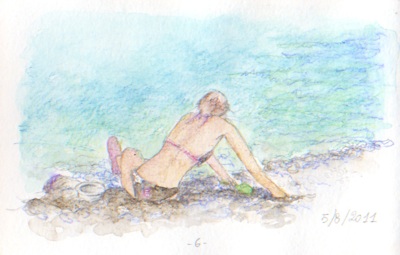
Una giovane mamma gioca con la sabbia sulla spiaggia
A young mother plays with sand on the beach


La Dalmazia con le sue isole è nota per le sue acque pulite e trasparenti, mentre non è affatto facile trovare spiagge ampie e comode, trattandosi di una costa frastagliata e rocciosa, spesso resa accessibile ai bagnanti da deludenti banchine in cemento.
A Korčula invece esistono belle spiagge di ciottoli, come quella di Pupnatska Luka, dove abbiamo passato una piacevole, riposante giornata circondate dal verde intenso delle colline ricoperte di pini e dai colori cangianti del mare e delle isole intorno.

Dalmatia with its islands is known for its clean, transparent waters, while it isn't easy at all to find wide, comfortable beaches, since the coast is rocky and jagged, often made accessible to bathers through disappointing concrete docks.
In Korčula instead there are beautiful pebble beaches, like the one of Pupnatska Luka, where we spent a pleasant, relaxing day surrounded by the intense green of the hills covered with pines and by the changing colours of the sea and the islands all around.